


On January 10, the summary workshop of the Commercial and Industrial Rooftop Solar Project (CIRTS) took place in Hanoi.
The event was organized by the Electricity and Renewable Energy Authority (Ministry of Industry and Trade) and the German International Cooperation Agency (GIZ) on behalf of the German Embassy in Vietnam to share the outstanding results of the project and discuss solutions to promote solar power development in the future.
With increasingly decreasing production costs, solar power is becoming a source of electricity with reasonable prices among other types of electricity sources. Vietnam has the potential to converge all favorable conditions to expand the development of solar power because of domestically produced equipment, low labor costs and high solar radiation.
With about 17 GW of solar power capacity in operation since 2020, Vietnam has become a leading country in solar power development in the ASEAN region. More than 100,000 rooftop solar power systems (RTSPs) have been installed, equivalent to nearly 50% of total solar power capacity, marking an important milestone for Vietnam's power system in achieving the national target on climate change (achieving zero net emissions by 2050). Recently issued legal documents such as Decree 80/2024/ND-CP of the Government regulating the mechanism for direct electricity trading between renewable energy power generation units and large electricity users and Decree 135/2024/ND-CP of the Government regulating the mechanism and policies to encourage the development of self-produced and self-consumed RTSPs have created a legal framework to promote the development of the RTSP market.
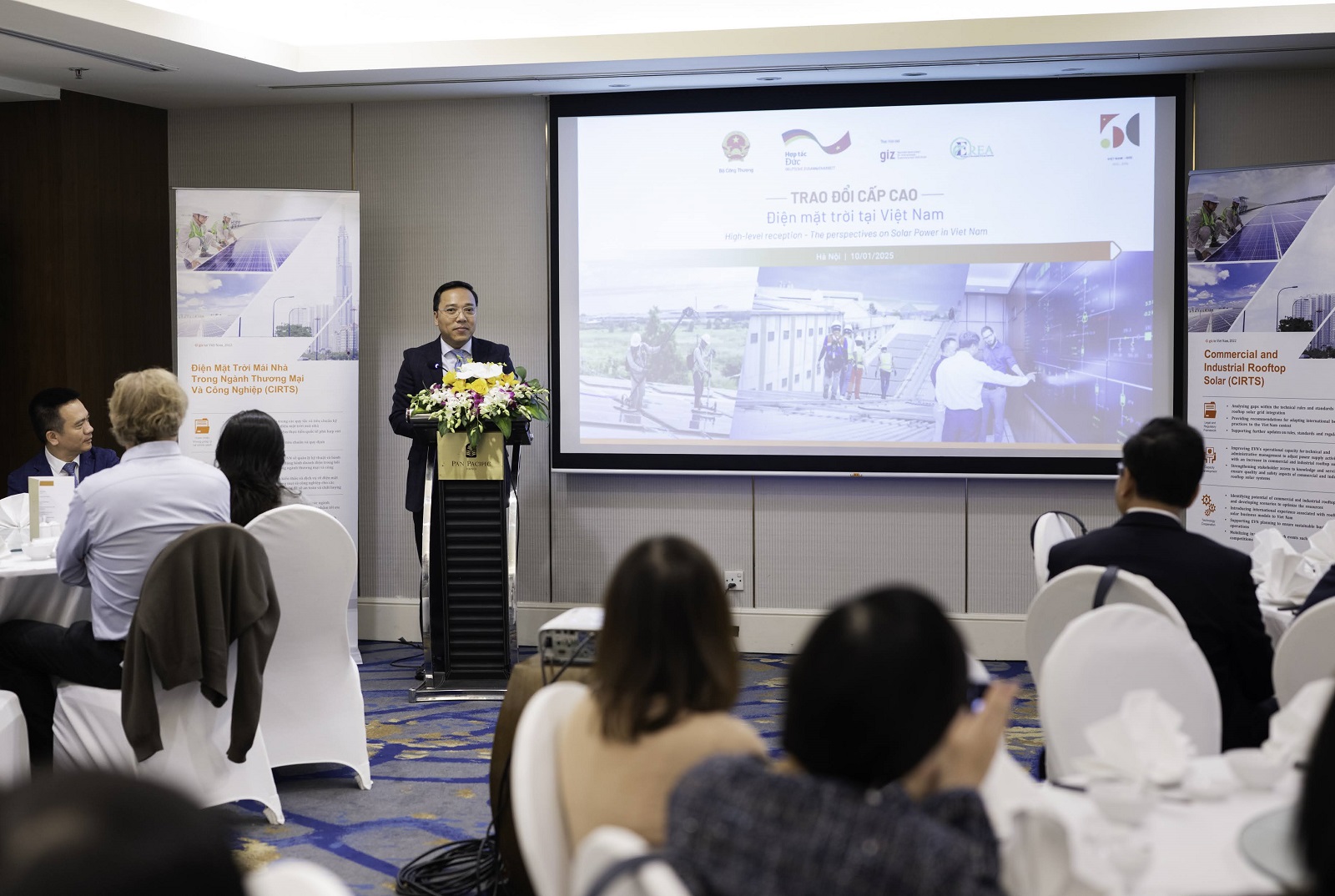
Nguyen Hoang Long - MOIT speaks at the event
In that context, the Electricity and Renewable Energy Authority (Ministry of Industry and Trade) has coordinated with the GIZ International Cooperation Organization to implement the CIRTS project. The project is funded by the German Federal Ministry for Economic Cooperation and Development (BMZ) and will be implemented from February 2021 to January 2025.
The CIRTS project aims to facilitate the sustainable development of rooftop solar power in Vietnam. The project aims to enhance the capacity of Vietnamese agencies in integrating rooftop solar power into the grid, including the Ministry of Industry and Trade and Vietnam Electricity (EVN).
The project also supports the resolution of technical, administrative, and regulatory issues on rooftop solar power operation and grid integration with the goal of providing clean, safe, and cost-effective electricity to the power system, contributing to building a solid foundation for the development of clean energy in Vietnam.
A key outcome of the project is to improve the performance and longevity of the solar PV system through operational and maintenance guidance and fire safety. For the solar PV system to operate well, Vietnam needs to ensure that the installation, operation and maintenance of the system is safe and effective. The CIRTS project has contributed to raising public awareness, supporting EVN to promote the implementation of quality standards and fire safety regulations, and developing operational and maintenance guidance to maintain the performance and longevity of the solar PV system. As a result, stakeholders in the solar PV sector can maximize the value of their systems, increase profits and electricity output from solar PV sources.
The project also helps strengthen the coordination and operation of the power system of EVN. EVN staff are better equipped to manage the current and future solar PV system, minimize solar power curtailment and operate the system efficiently. Some notable results include: improved accuracy in solar power output forecasting, enhanced coordination between transmission and distribution system operators (signed memorandum of understanding/data sharing cooperation agreement for load and solar power output forecasting) and recommended implementation plan for advanced distributed energy resource management system.
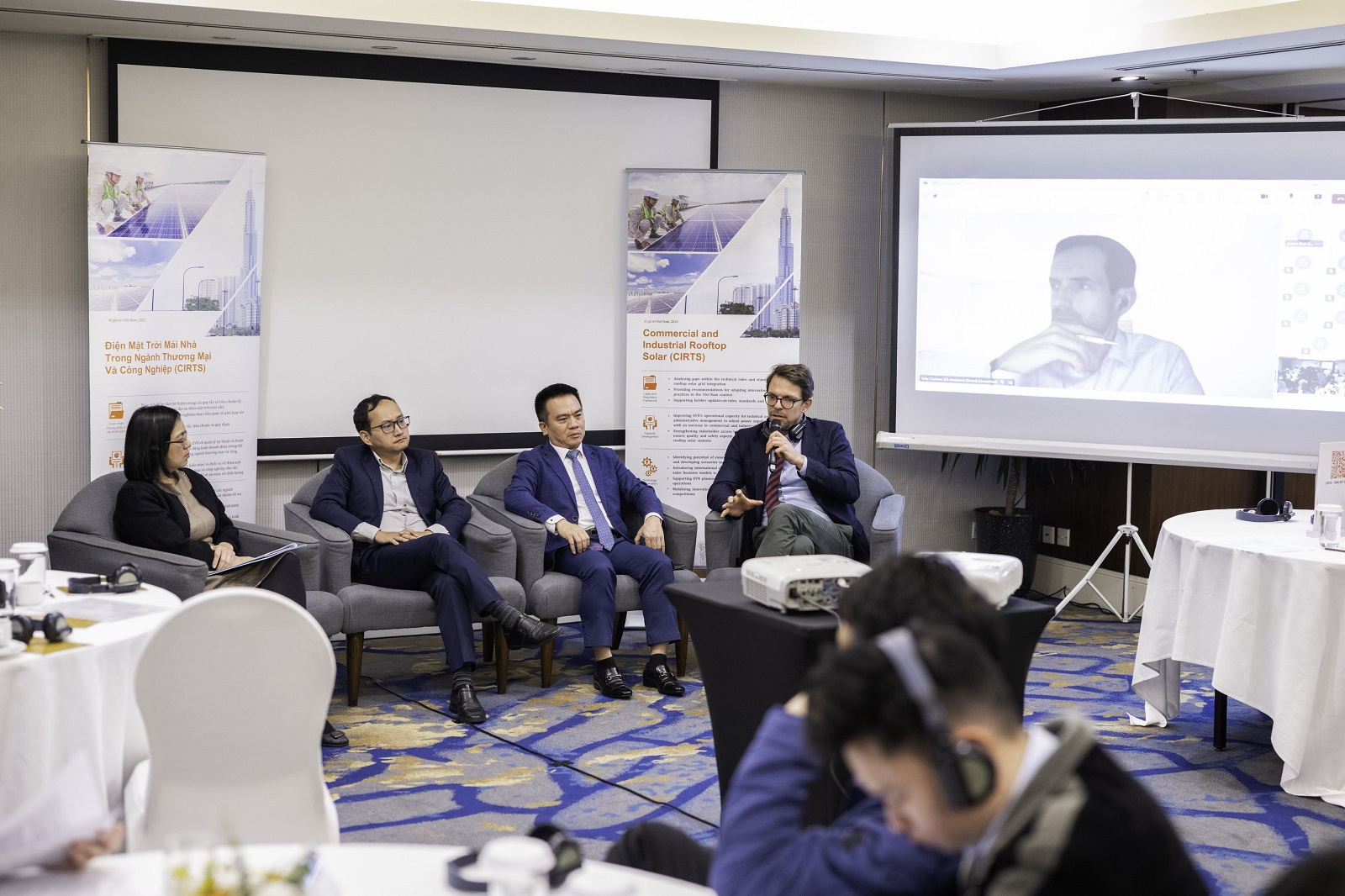
Speakers participating in the discussion session
At the same time, the project has expanded the training program on solar power. In coordination with the engineering, procurement and construction (EPC) contractor, the CIRTS project has developed documents to support the operation and maintenance of the solar power system. This document will be reviewed and contributed to the training program for technicians at vocational colleges nationwide.
The project also updates the solar power development policy through technical analysis. The CIRTS project supports the recovery of the solar power market through technical and legal advice on solar power development policy. This activity is promoted through coordination with other development partners and continues to be considered for promotion within the framework of supporting the development of a Resource Mobilization Plan to implement the contents of the Just Energy Transition Partnership (JETP).
Ms. Helga Barth, German Ambassador to Vietnam, emphasized that the great potential of solar power is an opportunity that can be easily grasped. She said: “The experience of both countries in developing solar power markets and integrating systems lays a solid foundation for future efforts. The development partnership between the two sides will help Vietnam continue to develop solar power in its energy mix, establishing a key pillar in the country’s carbon emission reduction strategy.”
Source: Clean Energy